

Amazon Clarifies Its New Product Title Rules: What Sellers Need to Know About Item Highlights
Amazon has provided further clarification on its July 2026 product title update, answering some of the biggest questions sellers and brand owners have had since the new requirements were announced.
The important takeaway is this: Amazon is not reducing the amount of product information you can provide. It is changing how that information is organized across the listing.
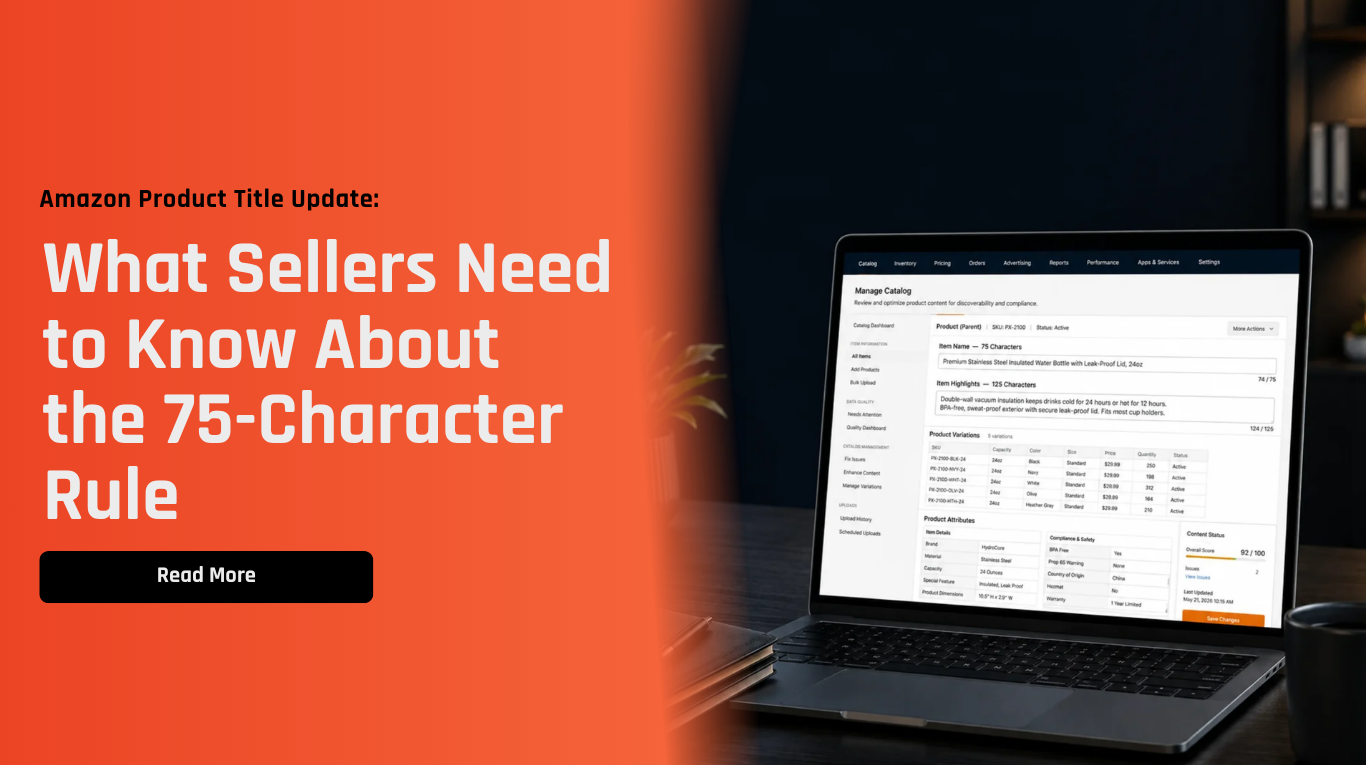
Product titles are now limited to 75 characters, while a new Item Highlights field provides an additional 125 characters for important product details.
Amazon also confirmed that both fields contribute to search and discoverability, meaning sellers do not need to treat Item Highlights as a secondary or less important search field.
For brands managing large catalogs, this is more than a title-editing exercise. It is a catalog management change that requires careful planning, consistency and quality control.
What Has Amazon Changed?
Amazon announced in June that, beginning July 27, 2026, product titles in most categories would need to be limited to 75 characters, including spaces. Media products are excluded from this requirement.
At the same time, Amazon introduced Item Highlights, which provides another 125 characters for information such as materials, recommended uses and other useful product details.
Amazon has now clarified that sellers effectively have 200 characters of product information across the two fields:
Item name: Up to 75 characters
Item highlights:Up to 125 characters
The objective is to make product information easier for customers to scan, particularly across different screen sizes.
Amazon also confirmed that both Item name and Item highlights are inputs for search. One is not prioritized over the other for discoverability.
That distinction matters.
Sellers should not simply shorten their titles and move everything else into Item Highlights without thinking about how the information is structured.
What Should Stay in the Product Title?
Amazon recommends keeping the brand name in the Item name, along with the most important product information.
For products with variations, Amazon recommends putting the most important variation attributes in the Item name as well.
For example, if color, size or pack count is critical to understanding the product, those details should be prioritized in the title where appropriate.
The challenge is deciding what deserves those limited 75 characters.
A strong title should quickly answer:
What is the product?
Who makes it?
What is its key identifying attribute?
What variation or important specification does the customer need to know?
The title is no longer the place to try to describe everything about the product.
It needs to identify the product clearly and efficiently.
What Belongs in Item Highlights?
Item Highlights give sellers additional room to communicate useful product information that does not fit naturally into the title.
Amazon specifically points to information such as materials and recommended use cases.
This creates an opportunity to separate product identification from product clarification.
For example:
Item name:
Stainless Steel Insulated Water Bottle, 32 oz, Black
Item highlights:
Double-wall insulation, BPA-free, leak-resistant lid, ideal for gym, travel and office
The exact content will depend on the product and category, but the principle is straightforward:
Use the title to identify the product. Use Item Highlights to add meaningful context.
This is a much cleaner approach than creating extremely long titles packed with every possible keyword and specification.
Does This Change Amazon Search Ranking?
According to Amazon's latest clarification, search discoverability is unchanged.
Both Item name and Item highlights are search inputs, and Amazon says neither is prioritized over the other. That means sellers should not panic about moving information out of the title.
However, "searchable" does not mean "put everything everywhere."
Repeating the same keywords across every field can make a listing harder to manage and potentially create unnecessary redundancy.
The better approach is to make each field useful. Your catalog should have a clear information hierarchy rather than simply trying to maximize keyword repetition.
Amazon Is Already Making Recommendations
Sellers should also understand that July 27 was not a hard deadline requiring every seller to manually rewrite every listing immediately.
Amazon began making recommendations for non-compliant listings from July 27 and will continue implementing changes throughout 2026.
Listings remain active, editable and searchable while this process takes place.
For brand owners, Amazon provides a 14-day review period before AI-generated changes are implemented.
This gives sellers an important opportunity: review the recommendations rather than simply accepting them automatically.
AI can help reduce the workload, especially across large catalogs, but product data still needs human oversight.
A machine can shorten a title. It may not understand which specification is commercially important to your customer, whether a variation attribute is essential, or whether the resulting title remains consistent with the rest of your catalog.
That is where catalog quality control matters.
Can Sellers Update Listings in Bulk?
Yes. Amazon has confirmed that sellers can use the Category Listings Report to manage the information at scale.
The report includes the Item name and Item highlights fields. Sellers can update the spreadsheet and upload it through the List Your Products tool.
Amazon says listings are typically updated within eight hours after upload.
For sellers managing dozens, hundreds or thousands of ASINs, this is particularly important.
Updating listings one by one may work for a small catalog, but it becomes inefficient and increases the risk of inconsistent formatting when the catalog grows.
Bulk editing should therefore be approached as an operational process, not simply a faster way to change fields.
Before uploading, sellers should have a clear structure for:
Title formatting
Brand placement
Variation attributes
Product specifications
Item Highlights
Category requirements
Character limits
Duplicate or redundant information
What About Product Variations?
Variation-heavy catalogs deserve special attention.
Amazon recommends keeping the most important variation attributes in the Item name. However, the 75-character limit may make it impossible to include every relevant attribute.
In those cases, sellers can move less critical information into Item Highlights.
This becomes particularly important for brands managing multiple parent-child relationships.
A title structure that works for one ASIN may not work across an entire variation family.
Before making bulk changes, sellers should therefore review how titles are structured across related products rather than treating every ASIN as an isolated listing.
Pro Tips from Xtended.Gh
1. Don't start by rewriting everything
Start with an audit.
Identify listings that are over 75 characters, listings with important information buried at the end, and products with inconsistent title structures.
Prioritize high-volume and high-visibility ASINs first.
2. Build a title hierarchy
Decide what information should always appear in the Item name.
For example:
Brand → Product Type → Key Attribute → Variation → Pack/Size
The exact structure will vary by category, but having a repeatable framework makes catalog management much easier.
3. Treat Item Highlights as part of the listing structure
Don't use the 125 characters simply as overflow space.
Use them intentionally for useful product information that helps customers understand, compare and select the product.
4. Review Amazon's AI recommendations
Amazon's recommendations can save time, particularly for large catalogs.
But automated recommendations should still go through a quality-control process before implementation.
5. Think about the catalog, not just the ASIN
A good title is useful. A consistent catalog is better.
When customers move between variations or related products, inconsistent naming can make a brand look less organized and make internal catalog management more difficult.
How Xtended.Gh Can Help
For brands managing Amazon catalogs at scale, changes like this can create a significant amount of backend work.
XtendedGH provides backend eCommerce operations support, including Amazon catalog and listing operations.
For this particular update, our support can include:
Listing audits: Reviewing product titles and identifying listings that require attention.
Catalog organization: Helping structure product information across Item name and Item Highlights.
Bulk listing operations: Supporting structured catalog updates and spreadsheet-based listing workflows.
Variation and attribute review: Checking that important variation information is positioned consistently across related listings.
Listing quality control: Reviewing updates for formatting, consistency and completeness before implementation.
The objective is not simply to make titles shorter. It is to help sellers maintain a cleaner, more consistent and better-organized catalog as Amazon's requirements evolve.
Final Thoughts
Amazon's title update is easy to interpret as a simple character-limit change. It is more useful to see it as a catalog information-management change.
The 75-character title forces sellers to prioritize the information that identifies the product, while Item Highlights creates additional space for meaningful product details.
For smaller catalogs, this may be a relatively straightforward cleanup exercise.
For larger catalogs, it is an opportunity to review how product information is structured across the entire catalog.
The brands that handle the transition well will not simply have shorter titles. They will have clearer, more consistent and better-organized product information.
And as Amazon continues to introduce more automated catalog recommendations, having a reliable backend process for reviewing, updating and maintaining listing data becomes increasingly important.
The goal should not be to outsmart the update.
It should be to build a catalog that remains accurate, useful and manageable as marketplace requirements continue to evolve.
Get in Touch
If your Amazon catalog needs to be reviewed or reorganized following the latest product title and Item Highlights changes, it may be time to strengthen your backend operations.
XtendedGH supports sellers with structured Amazon catalog and listing operations designed to keep product information organized, consistent and aligned with marketplace requirements. Book a session with our team, or reach out to our team at sales@xtendedgh.com to discuss your catalog support needs.
Frequently Asked Questions
Do I have to rewrite every product title?
No. Amazon is gradually applying recommendations to non-compliant listings throughout 2026. Sellers can also update listings themselves at any time.
Will moving information from the title to Item Highlights hurt search visibility?
Amazon says search discoverability is unchanged. Both Item name and Item Highlights are inputs for search.
How many characters can I use?
The Item name has a maximum of 75 characters, while Item Highlights provides an additional 125 characters.
Can I update titles and Item Highlights in bulk?
Yes. Amazon's Category Listings Report can be used to update the fields and upload them through the List Your Products tool.
Will Item Highlights appear to customers?
Yes. Starting August 10, 2026, Item Highlights will display beneath the Item name across desktop and mobile, although the amount visible on screen can vary by display.
Should I accept Amazon's AI-generated recommendations?
Not automatically. Amazon provides sellers with an opportunity to review, modify and approve recommendations. For important or high-volume catalogs, reviewing the changes before implementation is a sensible quality-control step.